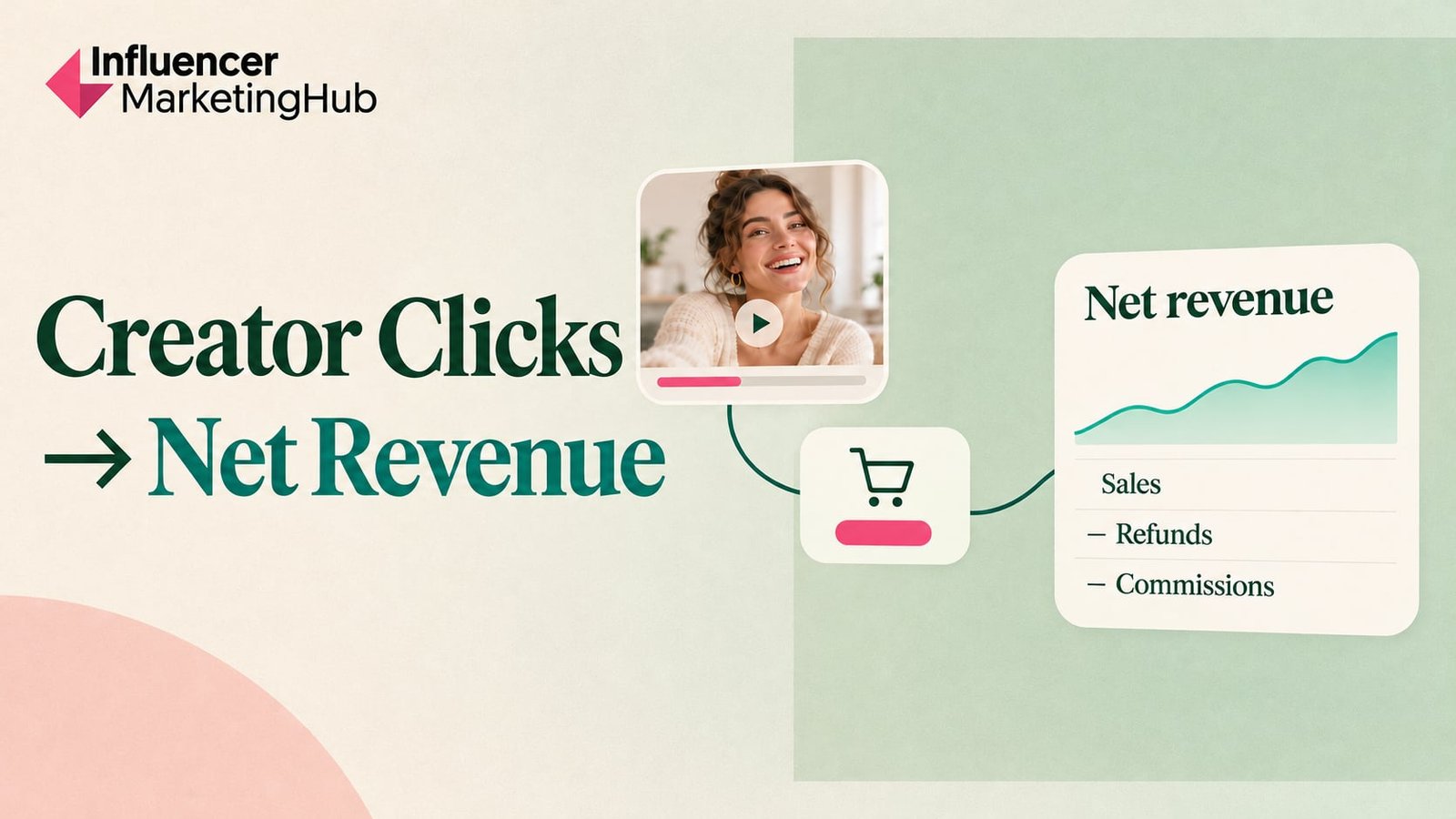
Creator campaign reports tend to lead with views, impressions and engagement, while the figure a finance team would want first, net revenue per creator against cost, is often missing. That is the argument in a piece from Influencer Marketing Hub, which lays out how sales-focused programs can close the gap.
Spending is rising, measurement lags
The article cites IAB’s 2025 Creator Economy Ad Spend & Strategy Report, which projected U.S. creator ad spend of $37 billion in 2025, up 26% year over year, and $44 billion in 2026. Influencer Marketing Hub’s own 2026 benchmark report found that among brands planning bigger influencer budgets, 89% chose brand awareness as a KPI, while 25% chose attributable revenue or sales.
Awareness is a legitimate goal, the outlet says, but reach does not show whether an audience is in the brand’s market or can buy. Clicks, sign-ups and trials are also only the start of a sale, since refunds, trial conversion and churn happen in other systems.
Building a traceable path
The piece recommends three basics. First, a tagged link for each creator, following Google’s guidance to use utm_source, utm_medium and utm_campaign, with utm_content to tell creatives apart. Consistent naming matters because inconsistent labels split one effort across several rows. It also warns that custom medium values can land in GA4’s Unassigned channel.
Second, a unique code per creator. The benchmark found discount codes used by 45.9% of respondents who answered, and affiliate links by 26.0%. Codes can catch cross-device buyers but also leak to coupon sites, so redemptions are evidence of influence rather than proof.
Third, a destination the brand controls, such as a creator-specific landing page that carries the tag forward.
The CRM as source of truth
The article advises storing first-touch details in first-party storage and writing them onto the order or CRM record, alongside the last touch. Revenue should then be reported net of returns and refunds, with a 90-day retention flag where relevant. Orders with no captured source should sit in their own row. The benchmark found reporting and analytics was the function least often outsourced to agencies, at 6.94%, which the author considers sensible.
It also cautions that GA4’s known-bot exclusion cannot catch automation that mimics ordinary browsers, so a traffic spike without more orders needs explaining before it is called a halo effect.
The scorecard
The proposed monthly scorecard lists each creator’s total cost, tagged sessions, orders or customers, net revenue, 90-day activity and net revenue per dollar of cost, plus rows for code-only redemptions and unknown sources. Costs should include seeding, usage rights and agency fees, and changes to tracking should be logged.
Because many creators generate only a few orders, the article recommends reading results on a rolling three-month basis and setting minimum thresholds before making decisions. It suggests that smaller creators with well-matched audiences may outperform larger accounts on net revenue, and that large-creator spend meant for awareness should be labeled as such.
Source: influencermarketinghub.com
Image: influencermarketinghub.com