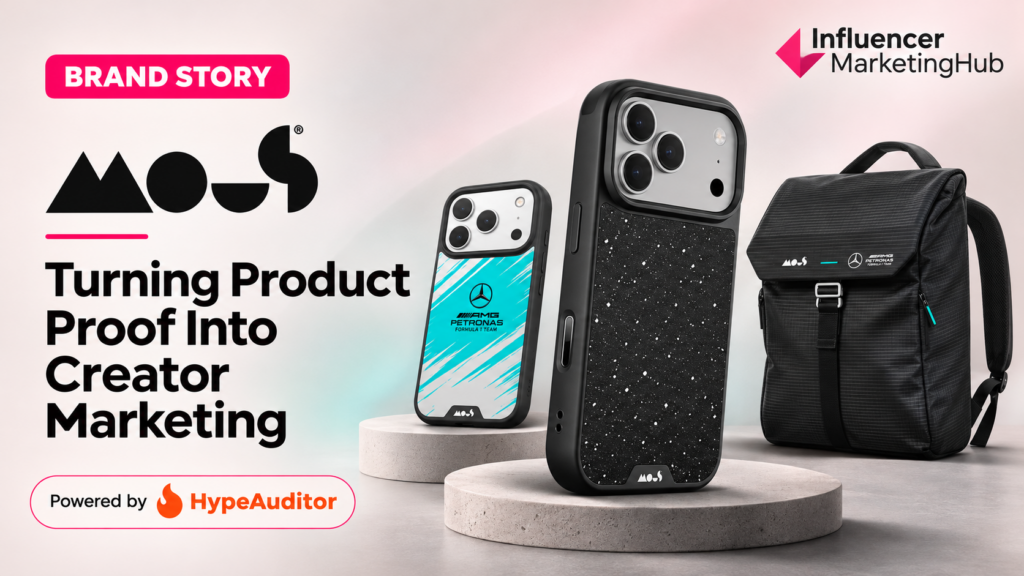
Tech accessory brand Mous has built its marketing around a simple idea: show what the product can survive. An analysis of the company’s strategy, published by an influencer marketing outlet that also ran its own HypeAuditor data, traces how that format grew from a crowdfunding video into a wider creator programme.
From crane drops to Formula 1
According to the source, Mous recently returned to television with an advertisement featuring Mercedes-AMG PETRONAS Formula 1 drivers George Russell and Kimi Antonelli, who tested the durability of the brand’s new luggage. Nearly a decade earlier, the founders dropped their own iPhones from a 45-foot crane to test their first protective cases. Mous calls its approach the Mous Mix: Dyson-style engineering paired with Red Bull-style marketing.
CEO and co-founder James Griffith said the company lost about £45,000 in savings after its first product, a case that stored wired headphones, ran into manufacturing problems and Apple’s removal of the headphone jack. The founders then moved to China to learn about manufacturing, and went on to develop the Limitless 1.0 case.
The first crowdfunding video struggled until the team added footage of the founders’ journey. The revised campaign raised $2.5 million in pre-orders from more than 50,000 backers.
Honest tests and episodic stories
Mous’s videos typically introduce an expensive device, build anticipation of damage, run the test, inspect the result and link it to the product. Griffith told Boxpark that a phone survived the 45-foot drop but was damaged from 60 feet, and that the company often shows products failing in its ads.
In 2024, Griffith challenged Piers Nathan, now Chief Marketing Officer, to throw a protected iPhone outside every Apple Store in the UK and double the brand’s social following, with tattoos as the stakes. Nathan travelled 1,837 miles. He missed the follower target, but Mous had its strongest month of follower growth to that point, and the final demonstration drew more than 1.2 million Instagram views. In 2026, in-house creator Isaac Relish wrote, directed and edited the company’s crowdfunding campaign.
Matching creators to product claims
The Mous Partners Program includes trials cyclist Danny MacAskill, downhill mountain biker Greg Minnaar and kitesurfer Tom Court. For a Made for Google magnetic case, Mous worked with mountain biker Sam Pilgrim, who tested the IntraLock mounting system at Google’s California headquarters, including a backflip over the Google sign.
Mous also worked with British parkour collective STORROR, which published a video on April 20, 2026, testing co-designed cases at a dam in Wales and offered a discount code. HypeAuditor’s analysis of Mous’s Instagram creator activity over six months found STORROR generated the highest estimated reach in the sample: 150.1K, about 63% of the total 238.2K. The collective has 1.7M followers; the featured post drew 5.6K likes and 29 comments.
A broader creator mix
Mous Collabs has also worked with artist Henry Fraser on case designs. The HypeAuditor data showed 16 creator accounts produced 18 tracked Instagram mentions, with nano and micro-influencers making up 11 of the accounts. Fourteen of the mentions, or 77.8%, were Reels. The source notes the sample covers only part of Mous’s cross-platform activity.
Source: influencermarketinghub.com
Image: influencermarketinghub.com